Posts By AJ
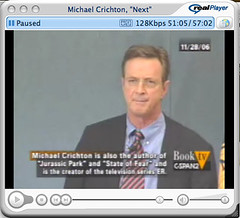
Author Michael Crichton Passes away
- Image by ~C4Chaos via Flickr
According to his site, author Michael Crichton died after an unsuccessful battle with cancer. Most famous for the novels Jurassic Park and the Lost World, I first read his book in school, namely Congo. Another of his book, The Andromeda Strain is a book on my reading list.
A very popular Sci-Fi author, he will be quite missed. The literary world has suffered a major loss today.

Heartbreak

- Image by Paul Genge via Flickr
Felipe Massa just lost the Formula 1 World Drivers Championship in the last 5 seconds of the last lap of the last race of 2008. And all due to another driver.
What a heartbreak. Now Lamilton is going to be insufferable. Even more than he is!
Augh.. But Vettel is my new hero. And Kubica too for his last lap stunt.
I was praying so hard for Vettel to not slip and not give up his position. And the entire last lap, my heart was beating as if I’d just run a race. I actually measured it too D:

Book Review: A Lifetime of Secrets: A PostSecret Book by Frank Warren
I have secrets. So do you and everyone else. We keep secrets out of embarrassment, fear of hurting others or importantly hurting ourselves. But a lot of times we keep secrets because we just do not know how to express our feelings – elation, hurt, sadness, love. The liberating effect of letting a secret out is the focus of the community powered and supported PostSecret project.
In 2004 Frank Warren launched a social experiment in community art, inviting strangers to mail him anonymous homemade postcards with their secrets written on them. The only rule is that it has to be a true secret that you have never before shared. Be creative he told the masses. The response he received was overwhelming.
The PostSecret idea is to ask the community to send their deepest secrets anonymously, written on postcards, decorated (usually as a collage) however the sender wants. Of these, Frank, as the editor of the PostSecret project selects the ones that touch him, and posts them on the blog, in a book (four books so far) or on the traveling exhibit. Warren doesn’t select for any particular theme just those which touch – some are happy, some sad; some are humorous, some morbid and some just of desolation. Almost all secrets are personal, many times an incident from the sender’s life, while some are just how they feel towards the world and life. Most times, those that connect the most with readers are the simplest (like “I still love you” or “I am stuck in my marriage”) and the most profound.
Each Sunday the PostSecret blog is updated with all new secrets sent by readers from all over the world. Each week it’s different set of secrets, which make the blogs readers laugh or cry, feel happy or sad and almost always empathize with the sender. PostSecret has become a social phenomenon in such a short time that it is one of the most widely visited blog on the Internet. The popularity of PostSecret can be explained by its therapeutic effect on the reader, the connection they make with the sender and most importantly the realization that others have deep, dark secrets too and hence they are not alone. Over time, the project has gained a cult following of readers of all ages – angst ridden teens, mid-life crisis affected women to the aged who miss their lost loved ones.
Over the course of the project, Frank has released four books containing a selection of the postcards sent to him over the years. The latest book, “A Lifetime of Secrets” is the most different. In A Lifetime of Secrets, Frank says “I’ve selected postcards that show how secrets can reveal a momentary impulse or haunt us for decades and arranged them by age to follow the common journey we all take through childhood, adolescence, adulthood, maturity. Stretched over a full lifespan, the secrets expose the meaningful ways we change over time, and the surprising ways we don’t.”
This fourth PostSecret volume, like the blog, is a collection of postcards. “A Lifetime of Secrets”, however, approaches the secrets a little differently, in that they are arranged chronologically, approximating the stages in one’s life. While the previous books were arranged thematically, this book is literally an attempt to present a progressive story — of life, a lifetime of secrets. Starting from childhood, the book span a child’s fear in the kindergarten, to the teen who wants to spill their love, to the elderly who “Just wants to die happy” The predominant feeling, while reading this book, is like taking a journey through life, and simultaneously going through the changing experiences as we grow older.
I have been following PostSecret since 2005 and have always found it to be thought provoking and on many occasions therapeutic. The connection that I made with many of the PostSecret writers, the feeling of “I feel the same as you” when reading any of the cards is sometimes just overwhelming. When I received this book, I lent it to a cousin who had just gone through a traumatic experience in life. As she read it, she found comfort in reading the secrets and a little peace of mind connecting with the others. I heartily recommend this book to any and everyone, of any age!
While I have not written any secrets myself, if you have a secret, Share it! Let it go, write to the project and I’m sure there will be someone out there who will identify with your secret, or come to the realization that they are not alone nor life as unforgiving as it seems. Liberate yourself and send your own secret to
PostSecret
13345 Copper Ridge Rd
Germantown, Maryland 20874
Book Review: The Black Lizard Big Book of Pulps, Edited by Otto Penzler


During the Great Depression, many authors wrote stories at a penny a word to make ends meet. Some of these authors wrote up to a million words a year, usually in the form of detective stories, mysteries and thrillers. A lot of these stories, featuring smart, cynical but brave detectives, were first printed in the wildly popular fiction magazines of the 20’s, 30’s and 40’s such as Black Mask, Dime Detective, Gangster Stories, and Gun Molls, printed on incredibly cheap pulp paper and were the medium for popular stories during the period between the world wars, through the great depression. This was the start of the fiction genre known as Pulp fiction
With the popularity of comics, cheap paperback novels, radio and television, the popularity of pulp magazines declined, eventually shutting many of them down for good, and thus depriving many of our generation of the guilty pleasure of this writing style. Yes guilty pleasure since the rate at which the authors churned out these stories did not allow them to write elegant prose or proofread and rewrite these stories. In a way, this actually established the form and style of writing, making them more gritty and identifiable with the populace in a period when earning a livelihood was tough and money was short.
The decline of the pulp magazines however, has not entirely deprived us of this genre of fiction. The Black Lizard has released a huge compendium of pulp stories collected in a single anthology called The Black Lizard Big Book of Pulps. Edited by Otto Penzler, one of the most authoritative sources on pulp fiction, owner of The Mysterious Bookshop in New York City, the book is telephone directory sized tome at over 1,000 pages contains 52 crime stories from the 20’s, 30’s and 40’s with their original artwork and also features two full novels. The book is printed in the two-column format as the old magazines were printed. Penzler provides the foreword to the book and has written notes before each of the stories, usually about the author and his other works.
Featured in this book are some of the best stories and every major writer who ever appeared in the popular pulp magazines of the time. The book contains three stories by Raymond Chandler, Cornell Woolrich, Erle Stanley Gardner, and Dashiell Hammett, the masters of the pulp genre and many other lesser-known authors of the time. The featured novels are by Carroll John Daly, the man who invented the hard-boiled detective, and Fredrick Nebel. These are the classic tales that created the pulp fiction genre and started the trend of the hard-boiled detectives.
However, the stories are not collected by authors but are instead divided into three sections – Crime Fighters, Villains, and Dames with the stories in each section following that theme. The Crime Fighters are the quintessential cynical, honest hard-boiled detectives who are either saving a damsel in distress or setting right wrongs perpetrated on the innocent. These detectives were so popular that they became iconic thanks to this genre. Some of the characters include Sam Spade, Captain Jerry Frost of the Texas Air Rangers, Phillipe Marlowe and others. The Villains section is interesting because many of the stories featured Robin Hood’esque characters who stole from the rich and gave to the poor. There were exceptions of course, like the unrepentant sociopath teenager in “You’ll always remember me” or the precious stone smugglers from The Monkey Murder.
In the age when these stories were written, there were not many women (outside of the movies) who accomplished a lot in the public eye. And this is reflected in these stories. The women in pulp fiction were usually secretaries, damsels in distress or in many cases, femme fatale on the arms of a crime boss. But a good many stories featured them in the role of the protagonist who used their beauty and brains to solve crime and save the day.
For pulp fiction fans, this book is a collector’s edition. While not all stories are great (or equally good to the others) the vast collection will ensure that almost all fans will find a lot to enjoy the book. Each of the stories are prefaced by Penzler’s editorial notes; especially helpful in putting the author, the stories and the heroes in perspective as well as serving as a background for readers who have not read pulp stories before. A highly recommended book for entertainment for many a days, this collectors edition is a must have.
dames, villains, Sam Spade, Captain Jerry Frost, Phillipe Marlowe
Project Confirmation
As a part of the 8 semester of my engineering course I am supposed to do a mini internship possibly in a company. Basically I need to develop a project for a demo in front of the university examiner…
Through an uncle who works there, I finally got a project in a company called Unisys Global Services – India. Initially they suggested a project which was quite interesting and we were ready todo it. But unfortunately our hod rejected it cos it was not good enough for some reason.
Well we were back to square one.We went back to the company and explained our situation. fortunately for us the PM there understood our problem and helpfully suggested that he would ask other PMs and get back to us with another topic.
Finally after more that 4 meeting with them, we got another project which, wonder of wonders was suitable to the college lecturers. Then another problem arose. There was a delay in seeking the company management approval. That was two days back.
But now finally our guide said he has received the approval and that we should be able to start on tuesday. We meet him again on monday to discuss some issues abt the project.
But all in all some good news about the project at last :-)
Thus speaketh